PPF Knowledge
PPF TPU Materials Explained — Aliphatic vs Aromatic, Yellowing, Self-Healing
Part of the PPF BRANDS topic hub

New to car film? car wrapping Hong Kong — The full guide covers film types, pricing, choosing a studio and local regulations.
'PPF' has become one of the most abused labels in the aftermarket. Films sold under that name today range from proper TPU (thermoplastic polyurethane), to TPH (a polyolefin/polyurethane hybrid), to plain PVC vinyl. The three look nearly identical for the first six months and diverge catastrophically at years three to five. This spoke goes one level deeper into TPU itself — aliphatic vs aromatic — because that single chemistry choice decides whether your PPF still looks factory-new after five Hong Kong summers. It is the technical companion to our pillar guide, 'Full-Car PPF Hong Kong 2026 Buyer's Guide', written for owners and detailers who already know the basics and want the chemistry that drives the buying decision.
1. What TPU actually is
TPU (Thermoplastic Polyurethane) is a segmented block copolymer built from alternating 'hard segments' (typically a diisocyanate reacted with a short-chain diol) and 'soft segments' (long-chain polyols). Hard segments give the film mechanical strength and abrasion resistance; soft segments deliver elasticity and the shape-memory behaviour that enables self-healing. It is that hard-plus-soft microphase-separated architecture that lets a single 165-micron film simultaneously resist stone chips, remain optically clear, stretch around complex curves, and heal light swirl marks.
| Metric / Parameter | Specification |
|---|---|
| Aliphatic TPU UV stability | 8–10+ years |
| QUV accelerated weathering test duration | 3000 hours |
| Self-healing effective trigger window | 30–50 °C |
| Full-car standard thickness | 7.5 mil (190 μm) |
| Full-car PPF starting price (LETS GET WRAP price band) | From HK$19,800 |
Any real paint protection film is a three-layer sandwich: a thin topcoat on the surface (hydrophobic, stain-resistant, self-healing), a bulk TPU layer forming 85–95% of the thickness (the mechanical backbone), and a pressure-sensitive adhesive (PSA) on the back that bonds to the paint. Typical full-car spec: 7.5 mil / ~190 μm total. Cut corners on any one of the three layers and the film's real-world performance collapses.
2. Aliphatic vs Aromatic — the molecule that decides everything
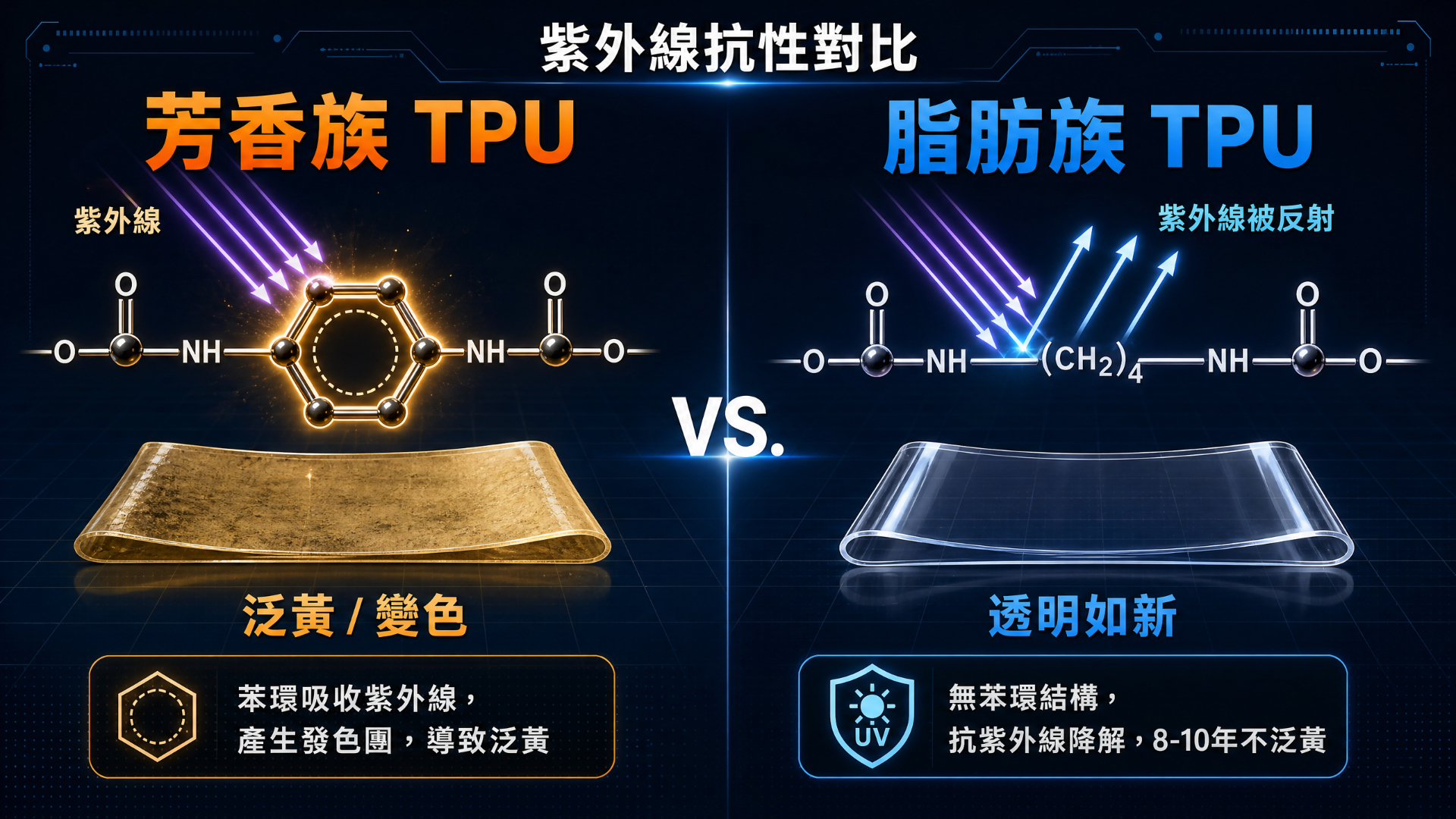
TPU is manufactured with one of two families of diisocyanate: aliphatic (HDI, IPDI) or aromatic (MDI, TDI). This one chemistry choice sets the film's UV resistance and yellowing behaviour more than any other spec on the datasheet — it is the single most important dividing line in the PPF market.
●Aromatic TPU
MDI/TDI-based, contains benzene rings. Under UV exposure the benzene rings form quinoid chromophores that shift the film progressively yellow. Raw material is ~30–40% cheaper; mechanical properties are actually fine. But in Hong Kong's UV climate the yellowing is visible on white or light-coloured cars within 12–24 months. Common in entry-tier films, TPH hybrids, and unbranded 'grey market' PPF.
●Aliphatic TPU
HDI/IPDI-based, no benzene rings in the polymer backbone, therefore no UV-driven chromophore formation. Stays clear and colour-stable for 8–10+ years of real UV exposure. Higher raw-material cost, but this is the required chemistry for every flagship film that ships with a '10-year non-yellowing warranty' — GSWF Defender all use aliphatic TPU.
●How to tell? Datasheet + warranty length
A legitimate manufacturer states 'Aliphatic TPU' or 'HDI-based' on the TDS. If the spec sheet only says 'TPU' with no qualifier, or the warranty is 3–5 years instead of 10, assume aromatic. Ask the installer for the original manufacturer's Technical Data Sheet, not a printed marketing brochure.
The financial reality for Hong Kong owners: between 2023 and 2025 LETS GET WRAP handled 40+ 'refit' jobs where the customer had installed aromatic TPU (or a TPH hybrid) three years earlier, only to find the front bumper and hood visibly yellow next to the door panels. The only fix is to strip and re-wrap. At roughly HK$20,000 per redo, more than half of the 'savings' from the initial 30% discount evaporates the second time round.
3. Yellowing tests: what does '3000-hour QUV' really mean?
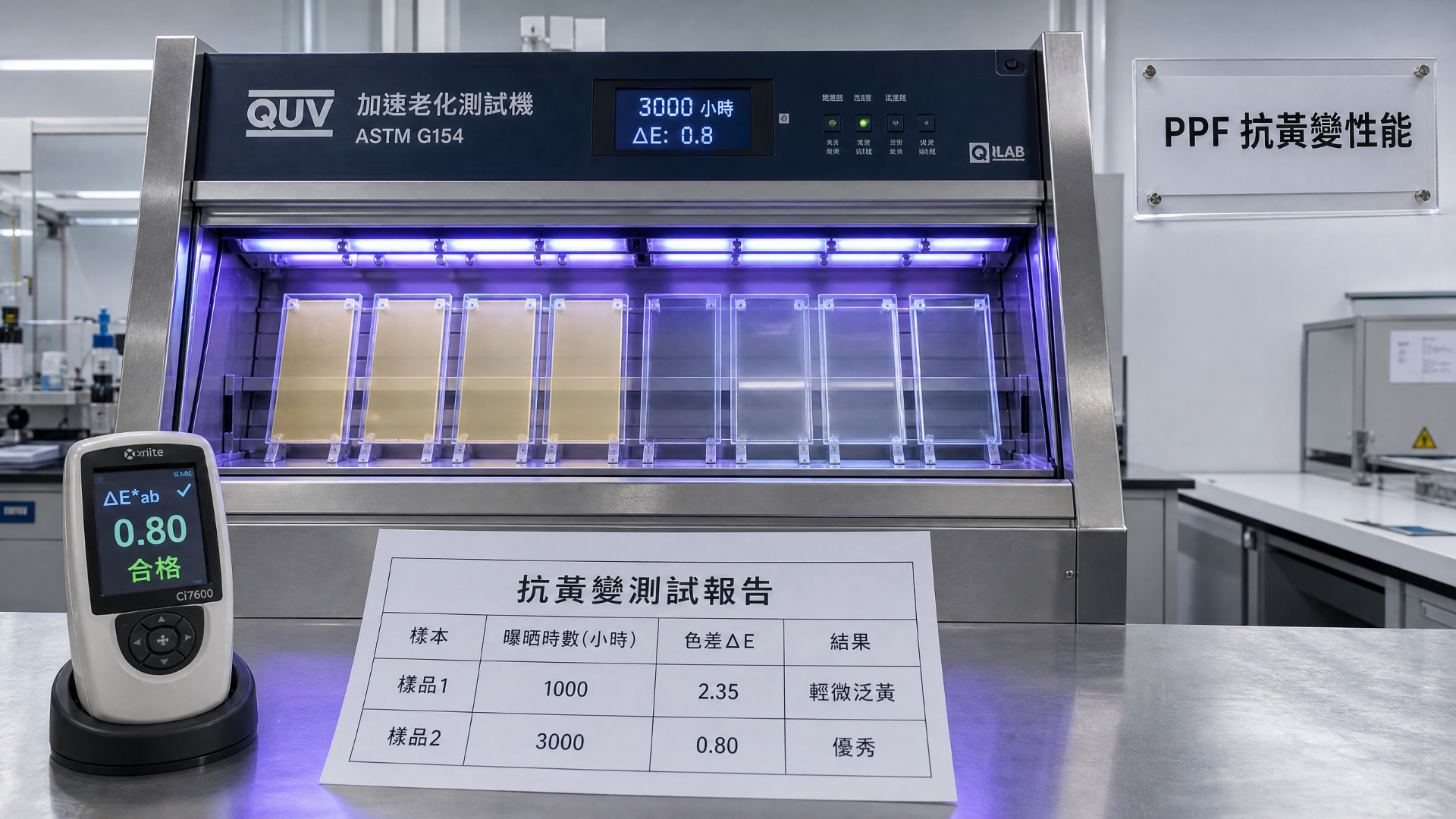
The industry-standard yellowing test is QUV Accelerated Weathering per ASTM G154, using UVA-340 lamps that reproduce the terrestrial solar UV spectrum and alternating cycles of UV exposure and condensation humidity. 3000 hours of QUV corresponds to roughly 5–7 years of outdoor Hong Kong exposure.
●ΔE (colour difference)
Measured before and after. ΔE < 1.5 is invisible to the naked eye; 2–3 is faintly perceptible yellowing; > 5 is obvious. Flagship aliphatic PPF typically returns ΔE < 1.0 after 3000 h; aromatic TPU comes in at 3–6; PVC film is often > 10.
●Yellowness Index (YI)
The complementary metric — the lower the increase in YI, the better. Reference numbers: GSWF Defender publishes ΔYI < 0.8 at 3000 h; GSWF Defender publishes ΔYI < 1.0; typical entry-tier aromatic TPU sits at ΔYI 4–8.
●Translating to real Hong Kong life
Hong Kong's annual UV index runs 40–60% higher than temperate climates, and ambient humidity sits above 70% most of the year. Real-world ageing typically runs 1.2–1.5× faster than QUV lab results, so 3000 h QUV is a conservative proxy for about 5 years of daily HK use.
You have every right to ask a brand for the actual test report. Genuine manufacturers can provide third-party lab certificates (SGS, Intertek, etc.) with signatures and dates. If all that's on offer is a colour bar chart printed by the manufacturer itself, with no lab log or ASTM reference, treat it as marketing.
4. Self-healing: the chemistry behind the 30–50 °C window
●Step 1 – Confirm scratch depth
Check that the swirl or scratch is contained within the topcoat layer.
●Step 2 – Select heat source
Use a standard hair dryer or warm water instead of an industrial heat gun.
●Step 3 – Apply controlled warmth
Hold hair dryer 20–30 cm away on medium heat for 2–3 minutes or pour warm water.
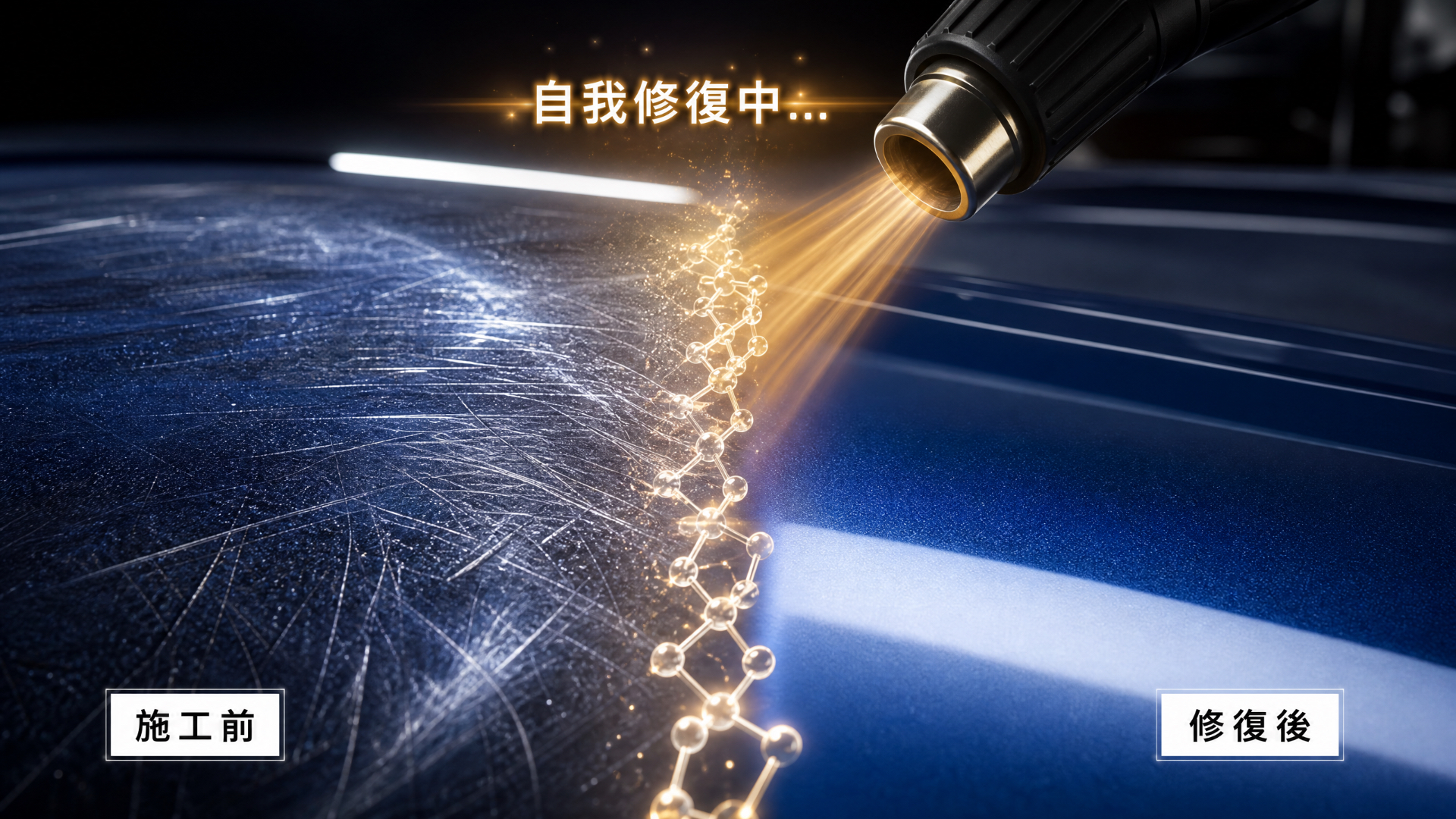
Self-healing lives in the topcoat, not in the TPU bulk. Flagship topcoats are elastomeric polyurethane systems with a lightly crosslinked, shape-memory network. When a fine scratch (wash swirl, fingernail mark, micro stone chip) disturbs the network, heat energises the polymer chain segments and lets them re-flow into their original shape, closing the scratch.
●Effective trigger: 30–50 °C
Below 30 °C, healing is extremely slow. Around 50 °C, visible scratches disappear in minutes. Above 60–70 °C, healing accelerates but you risk over-softening the topcoat, so never point a heat gun directly at the film.
●Hong Kong summers = free self-healing
From June through September, sun-exposed panels regularly hit 55–65 °C at midday. That places the topcoat squarely in its most active healing range. It is a large part of why well-installed PPF in Hong Kong still looks glassy at year three — half the credit goes to the climate.
●Winter and shaded panels: heat it yourself
A hair dryer on medium heat, 20–30 cm away for 2–3 minutes, or a warm-water rinse, is enough to trigger healing. Never use an industrial heat gun (200 °C+) directly on PPF — it will melt the topcoat.
●What self-healing does NOT fix
Only topcoat-depth scratches (roughly the top 5–15 μm). A deep gouge that cuts through into the TPU bulk — think a metal key hard-drag — is permanent. That kind of damage requires a partial re-wrap of the affected panel.
5. Thickness: 7.5 / 8 / 8.5 mil — how to choose
| Thickness Spec | Recommended Application | Key Characteristics |
|---|---|---|
| 7.5 mil (190 μm) | Full-car standard | Handles everyday stone chips; conforms well to complex curves |
| 8 mil (203 μm) | Front-third upgrade | 20–30% more impact resistance; harder to conform on deep curves |
| 8.5 mil (216 μm) | Front-end / rock-guard upgrade | Maximum chip resistance; slightly more visible edge line on light paint |
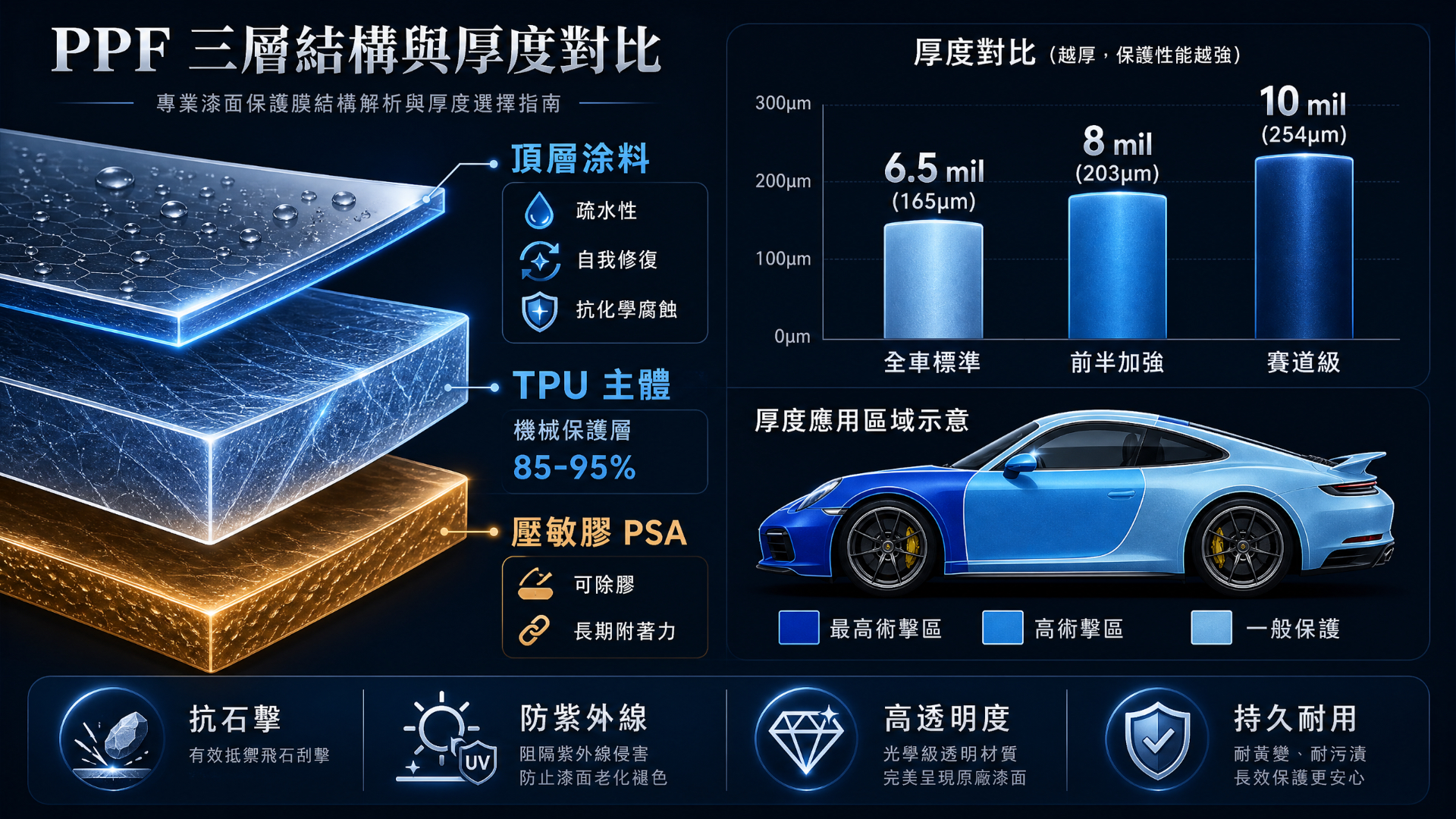
Thickness (measured in mils; 1 mil ≈ 25.4 μm) drives chip resistance, conformability, and price. Three common specs are on the market today.
●7.5 mil (190 μm) — full-car standard
The dominant spec for full-car wraps. Handles everyday stone chips and light branch scrapes without issue, conforms well to complex curves, and suits the vast majority of daily-driven cars and street sports cars. For a normal daily driver, this thickness is already optimal.
●8 mil (203 μm) — front-third upgrade
Recommended on the hood, front bumper, and mirror caps — the zones that take the highest chip risk. About 20–30% more impact resistance than 7.5 mil, at the cost of slightly harder conformability on deep-curved bumpers. The 'full-car 7.5 mil + front-third 8 mil' combo is the value sweet spot for most owners.
●8.5 mil (216 μm) — front-end / rock-guard upgrade
The heaviest street-usable spec. Recommended for the front bumper, hood leading edge and rocker panels on cars that regularly see gravel, track kerbs, or narrow urban lanes with active debris. Maximum chip resistance in the range, with a slightly more visible edge line on light-coloured paint — best deployed as targeted reinforcement rather than a full-body wrap.
Common misconception: thicker = better. In reality, over-thick film wrinkles on curves, is harder to edge-wrap, and produces a visible 'film sheen' on light paint. A full-car 8.5 mil install can actually make a beautiful car look plasticky. Our practical recommendation: 7.5 mil full-car + 8 mil on the front bumper alone. That's the sweet spot for street cars in Hong Kong.
6. Topcoat chemistry: hydrophobicity, stain resistance, chemical resistance
Bare TPU tends to attract oils and organic residue. Every modern PPF ships with a topcoat that defines the day-to-day driving experience — whether water beads or sheets, whether bird droppings etch a mark, whether tree sap eats the surface.
●Water contact angle
The standard hydrophobicity metric. > 100° = strongly hydrophobic; > 110° = top-tier (water sheets off at 40+ km / h). GSWF Defender publishes 115°; GSWF Defender around 105°; GSWF Defender around 110°.
●Bird droppings and insect residue
Premium topcoats buffer mild acid/alkali attack, so overnight bird droppings or bugs usually don't etch immediately. Past 24 hours, especially in summer heat, even top-tier film will develop a faint white haze where the acidity cooked in. Self-healing does not replace prompt cleaning.
●Chemical resistance
Resists petrol, DOT4 brake fluid, and pH 3–11 shampoos. Do NOT let strong alkaline wheel cleaner (pH > 12) or degreaser sit on the film — the topcoat will hydrolyse, followed by adhesive lift at the edges.
●Ceramic coating on top of PPF?
Fully recommended. A SiO₂ ceramic layer (Gtechniq Crystal Serum, CQuartz UK 3.0) on top of PPF pushes contact angle to 115–120° and further improves stain and dust rejection. LETS GET WRAP's full-car PPF package includes one round of Koch-Chemie ceramic coating.
7. The pressure-sensitive adhesive (PSA): bonds hard, removes clean
The bottom layer of any PPF is a Pressure-Sensitive Adhesive that determines both installation quality and how cleanly the film comes off five to ten years later. Flagship PPF uses acrylic-based PSA formulated for low initial tack (so the installer can reposition during application) plus high long-term adhesion (so edges stay down for a decade). Done right, removal at end-of-life leaves no residue and does not lift original paint.
Common PSA failure modes on cheap film: (1) initial tack too high, so mispositions can't be corrected; (2) adhesive hardens over years and pulls paint on removal; (3) adhesive oozes from edges, attracting dust and creating a black outline. Ask the installer for the manufacturer's PSA spec sheet, and check whether the warranty includes a 'clean removability' clause.
8. Practical checklist before you buy
●✅ Five questions you must ask
(1) Aliphatic or aromatic TPU? (2) Do you have a 3000 h QUV report with ΔE / ΔYI numbers? (3) What is the topcoat's water contact angle? (4) Is there a clean removability clause in the warranty? (5) Is the 10-year warranty issued by the brand HQ or self-signed by the installer?
●❌ Instant red flags
(1) Only says 'TPU', refuses to specify aliphatic; (2) Warranty capped at 5 years or shorter; (3) Cannot produce the original manufacturer TDS; (4) Quote is 30%+ below comparable market; (5) Marketing leans on vague phrases like 'imported film' or 'German technology' with no brand, no model number.
●🎯 Recommended HK market picks
Flagship: GSWF Defender or GSWF Defender (for maximum brand recognition and warranty portability). Value king: GSWF Defender Aliphatic TPU — LETS GET WRAP full-car from HK$19,800 with a 10-year non-yellowing warranty.
9. Further reading
Back to the pillar: 'Full-Car PPF Hong Kong 2026 Buyer's Guide' — /en/blog/full-car-ppf-hong-kong-2026-buyer-guide
Spoke 3 (installer checklist): 'Choosing a PPF Installer in Hong Kong — 12 Questions to Ask' — /en/blog/how-to-pick-ppf-installer-hong-kong-checklist
Marque-specific guides: Tesla → /en/blog/tesla-ppf-buying-guide-model-3-y-full-car-protection; BMW → /en/blog/bmw-ppf-buying-guide-full-car-top-tier-protection; Porsche → /en/blog/porsche-ppf-buying-guide-pts-360-protection.
Want the LETS GET WRAP engineering team to spec the right TPU + brand for your car? WhatsApp +852 5566 3699 or book at /en/booking — we reply with a full quote within 30 minutes.
Related reading: PPF services overview · PPF maintenance SOP
Authoritative sources: XPEL official PPF product page · HK Transport Department vehicle condition guidance
Ready for a professional PPF install?
Book LETS GET WRAP today
Our GSWF Tier-1 certified team will spec the right protection package for your car.
Get in touch


![[Ultimate Car Detailing Guide] PPF vs Ceramic Coating vs Waxing: Which One Suits Your Car?](https://wsrv.nl/?url=www.letsgetwrap.com%2F__l5e%2Fassets-v1%2F12f76392-685b-4c6d-971d-0f8aad7d2961%2Fppf-vs-coating-wax-cover-v2-en.webp&w=800&output=webp&q=78)


